
- Home
- Balance Transfer
Why Choose Balance Transfer?
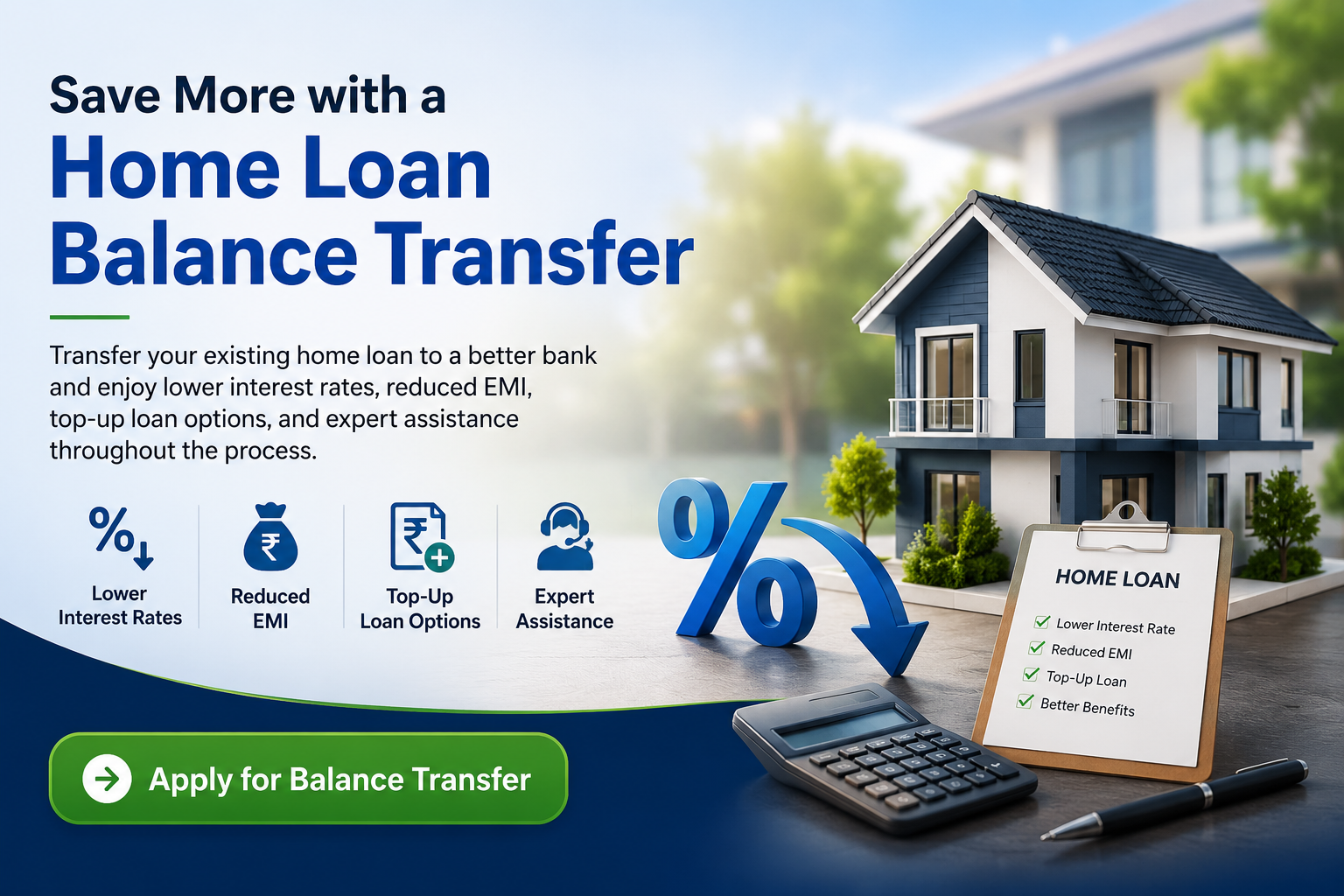
Reduce your monthly EMI and save more on interest by transferring your existing home loan to a bank offering better terms. We help you compare multiple lenders, secure competitive interest rates, and complete the entire balance transfer process with ease.
✅ Lower Interest Rate
✅ Reduced Monthly EMI
✅ Save on Total Interest
✅ Top-Up Loan Facility
✅ Quick Processing
✅ Expert Documentation Support

Benefits of Balance Transfer
✅ Lower Interest Rate
✅ Reduced EMI
✅ Better Loan Terms
✅ Top-Up Loan Option (Subject to Eligibility)
✅ Faster Approval Process
✅ Complete Documentation Support
✅ Dedicated Relationship Manager
✅ Multiple Bank Comparison

When Should You Transfer Your Loan?
✅ Your current interest rate is higher than market rates.
✅ You want to reduce your monthly EMI.
✅ You need an additional Top-Up Loan.
✅ You want better customer service from another bank.
✅ You wish to save on total interest over the remaining loan tenure.

Partner Banks







Top-Up Loan Facility
Eligible customers can also apply for a Top-Up Loan along with the Balance Transfer for:
✅ Home Renovation
✅ Business Expansion
✅ Education
✅ Medical Expenses
✅ Personal Financial Needs

Apply For Balance Transfer
Calculator Information
The Equipment Finance Calculator calculates the type of repayment required, at the frequency requested, in respect of the loan parameters entered, namely amount, term and interest rate. The Product selected determines the default interest rate for personal loan product. The Equipment Finance Calculator also calculates the time saved to pay off the loan and the amount of interest saved based on an additional input from the customer. This is if repayments are increased by the entered amount of extra contribution per repayment period. This feature is only enabled for the products that support an extra repayment. The calculations are done at the repayment frequency entered, in respect of the original loan parameters entered, namely amount, annual interest rate and term in years.
Calculator Assumptions
Length of Month
All months are assumed to be of equal length. In reality, many loans accrue on a daily basis leading to a varying number of days interest dependent on the number of days in the particular month.
Number of Weeks or Fortnights in a Year
One year is assumed to contain exactly 52 weeks or 26 fortnights. This implicitly assumes that a year has 364 days rather than the actual 365 or 366.
Rounding of Amount of Each Repayment
In practice, repayments are rounded to at least the nearer cent. However the calculator uses the unrounded repayment to derive the amount of interest payable at points along the graph and in total over the full term of the loan. This assumption allows for a smooth graph and equal repayment amounts. Note that the final repayment after the increase in repayment amount.
Rounding of Time Saved
The time saved is presented as a number of years and months, fortnights or weeks, based on the repayment frequency selected. It assumes the potential partial last repayment when calculating the savings.
Amount of Interest Saved
This amount can only be approximated from the amount of time saved and based on the original loan details.
Calculator Disclaimer
The results from this calculator should be used as an indication only. Results do not represent either quotes or pre-qualifications for the product. Individual institutions apply different formulas. Information such as interest rates quoted and default figures used in the assumptions are subject to change.
Feel free to use our EMI Calculator
**Note: For exceeding 120 no. of payments, a group of 12 payments will be combined into a single payment number for better chart visibility.
| Period | Payment | Interest | Balance |
|---|
FAQ
What is the minimum CIBIL Score?
Most banks and financial institutions prefer a CIBIL score of 750 or above for faster loan approval and better interest rates. However, some lenders may consider applications with a score of 650–700, depending on factors such as your income, employment stability, repayment history, and loan amount. A higher CIBIL score generally increases your chances of approval and helps you secure more favorable loan terms.
Which bank gives the lowest rate?
There is no single bank that always offers the lowest interest rate. Loan interest rates vary based on factors such as your CIBIL score, income, employment type, loan amount, tenure, and the bank’s current lending policy. We recommend comparing offers from multiple banks and financial institutions to find the most competitive interest rate and loan terms for your needs.
How much loan can I get?
The loan amount you are eligible for depends on several factors, including your monthly income, existing EMIs, CIBIL score, age, employment type, loan tenure, and the lender’s eligibility criteria. Use our Loan Eligibility Calculator to get an instant estimate of the loan amount you may qualify for. Final approval and the sanctioned amount are determined by the respective bank or financial institution.
Can self-employed people get a loan?
Yes. Self-employed individuals, including business owners, professionals, freelancers, and consultants, can apply for loans. Eligibility depends on factors such as business stability, income, CIBIL score, bank statements, income tax returns (ITRs), and repayment capacity. Meeting the lender’s eligibility criteria can improve your chances of approval and help you secure better loan terms.
FAQ'S
What is a Home Loan Balance Transfer?
A Home Loan Balance Transfer is the process of transferring your existing home loan from your current lender to another bank or financial institution that offers a lower interest rate or better loan terms. This can help you reduce your monthly EMI, save on total interest costs, and access additional benefits such as a top-up loan, flexible repayment options, and improved customer service. Before transferring, it’s important to compare interest rates, processing fees, and overall savings to ensure the switch is financially beneficial.
Can I get a Top-Up Loan?
Yes. Many banks and financial institutions offer a Top-Up Loan when you transfer your existing home loan, provided you meet their eligibility criteria. A top-up loan allows you to borrow additional funds over your existing home loan for purposes such as home renovation, education, medical expenses, business needs, or other personal financial requirements. The loan amount depends on your repayment history, income, property value, and the lender’s policies.
How much can I save?
The amount you can save depends on your outstanding loan amount, the difference between your current and new interest rates, the remaining loan tenure, and any applicable processing fees. Even a small reduction in the interest rate can significantly lower your monthly EMI and reduce the total interest paid over the life of the loan. Our experts can help you compare offers from multiple banks to estimate your potential savings before you decide to transfer your home loan.
Are there any processing charges?
Yes. Most banks and financial institutions charge a processing fee for a home loan balance transfer. The fee varies from lender to lender and is usually a small percentage of the loan amount or a fixed amount. Some banks may also offer promotional waivers or discounted processing fees. Before transferring your loan, it’s important to compare the total cost, including processing charges, to ensure the balance transfer provides overall savings.
How long does the process take?
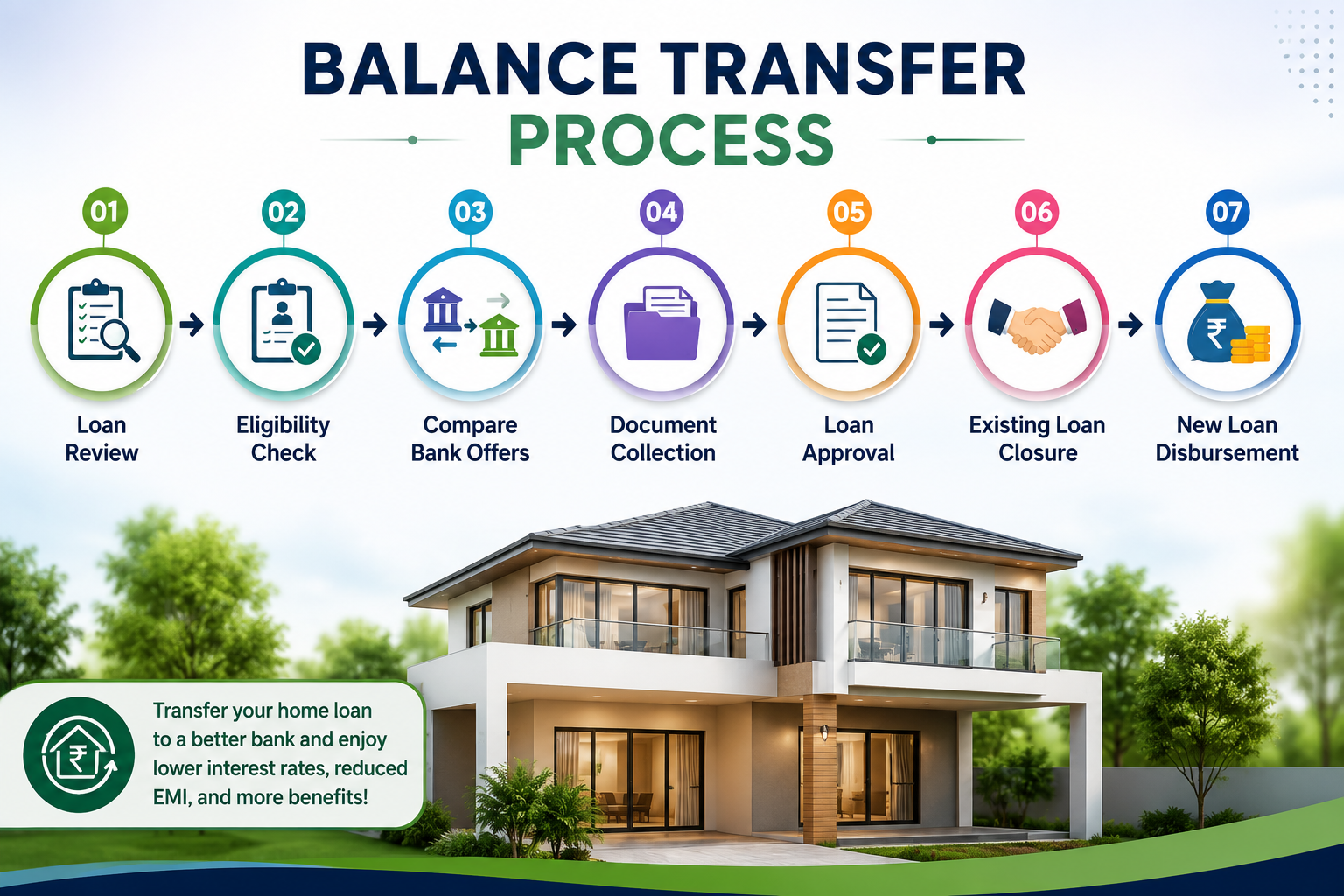
The balance transfer process typically takes 7 to 15 working days, depending on the lender, document verification, property evaluation, and the closure process with your existing bank. Submitting all required documents accurately and responding promptly to any additional requests can help speed up the approval and disbursement process.